Go NAPSACC comes from over two decades of work helping ECE programs set young children up for lifelong health and well-being.
Create
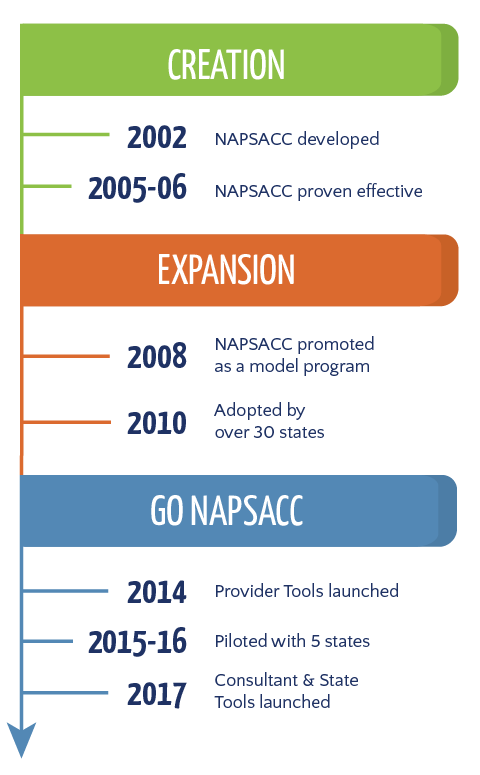
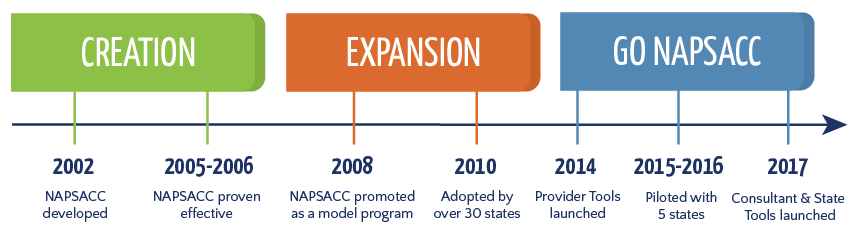
In 2002, a team of childhood obesity prevention researchers at UNC-Chapel Hill created NAP SACC. Key stakeholders, such as early childhood educators, consultants, other early care and education experts, and parents guided NAP SACC's development. Their input along with current research and national health recommendations were the basis for our evidence-based practices. These evidence-based practices represent important actions ECE programs can take to shape children's health and well-being.
NAP SACC originally offered self-assessment, action planning, and educational tools. These tools helped ECE programs prioritize, plan, and make improvements to their healthy eating and physical activity practices, policies, and environments. We trained local technical assistance providers as NAP SACC consultants. They used these paper-based tools to coach programs through the 5 Steps of NAP SACC.
Early evaluations of NAP SACC found that ECE programs improved their healthy eating and physical activity practices, policies, and environments after taking part in the program. Multiple external evaluations also found positive changes using NAP SACC. Summaries of these studies can be found on The Evidence page.
Disseminate
In 2008, the Center for Excellence in Training and Research Translation named NAP SACC as an effective, evidence-based program. A White House report called NAP SACC a "model program" to promote healthy habits in ECE programs. This promotion brought NAP SACC to a national audience. As a result, more than 30 states adopted the paper-based NAP SACC, making it a widely used tool for improving healthy eating and physical activity in ECE. It has even been adapted for international use in Australia and the United Kingdom.
In 2014, the next generation of NAP SACC went live with Go NAPSACC, the online platform. Our mission continued to help ECE programs create environments that support healthy habits in young children. Key updates include:
- Interactive, easy-to-use online tools for ECE programs, consultants, and state partners.
- Expansion to include evidence-based practices, self-assessments, and action planning for the following modules: Breastfeeding & Infant Feeding, Child Nutrition, Infant & Child Physical Activity, Outdoor Play & Learning, and Screen Time
- Tailoring of evidence-based practices for different settings such as family child care homes and part-time programs
Sustain
In 2018, the Farm to ECE and Oral Health modules were added to Go NAPSACC, expanding the topic areas available to support healthy ECE environments.
Go NAPSACC continued to gain recognition for its impact. In 2019, researchers from Harvard and Healthy Eating Research identified Go NAPSACC as showing the best evidence for reducing early childhood obesity risk, with the potential to prevent 38,000 cases and save $30 million in healthcare costs over 10 years.
In 2021, Go NAPSACC launched 35 online on-demand ECE program professional development trainings to help early childhood educators learn new skills and work towards their goals in all 7 Go NAPSACC modules.
Go NAPSACC continues to evolve to meet emerging needs. In 2026, the Social Emotional module was added, strengthening Go NAPSACC's ability to support a whole child approach to young children's health and well-being.
As of early 2026, Go NAPSACC has reached more than 14,000 ECE programs, helping create healthier ECE environments for children across the United States and beyond.
Whether you're an early childhood educator or a consultant, Go NAPSACC makes it easier than ever to give the children in your community a healthy start. Find out how you can join our NAPSACC Nation.